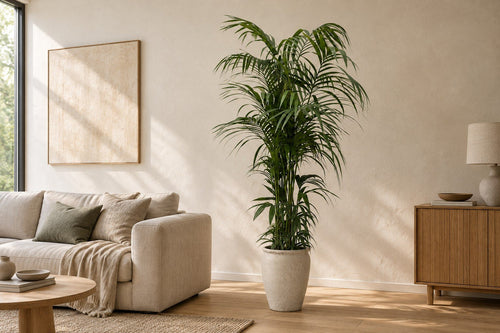
Dracaena, also known as dragon tree or corn plant, comes as marginata, Janet Lind, Golden Coast and Compacta, single-stemmed or branched. It copes with lower light and only needs water once the soil has dried out.
This collection has 25 Dracaenas from 100 to 220 cm tall, priced from €49.95 to €324.95. We measure height from the bottom of the pot to the tallest leaf. The varieties differ mainly in leaf shape and colour.
Dracaena marginata: narrow, pointed leaves on thin trunks, clean and graphic, branched up to 220 cm
Dracaena fragrans, such as Janet Lind, Janet Craig and Cintho: broader, glossy green leaves
Variegated types such as Golden Coast, Lemon Lime, White Stripe and Hawaiian Sunshine: leaves with yellow, light green or white stripes
Dracaena draco: sturdy, grey-green leaves on a thick trunk, 100 cm tall
A branched plant adds volume in width and fills a corner. A plant with a single straight trunk or a few trunks side by side fits a narrow space better, for example next to a cabinet or in a hallway.
Position and light
All Dracaenas in this collection like partial shade. Put them in a bright spot without harsh midday sun, because direct sunlight can cause brown patches on the leaves. Variegated types need more light than dark green ones to keep their colour. Green varieties such as Janet Craig can stand a bit further from the window. Avoid draughts and a spot right above a radiator.
Watering and maintenance
We list Dracaena as low maintenance or easy care. Let the soil dry out for the most part between waterings and then water thoroughly. Overwatering is the most common cause of yellow leaves and rotting trunks. In winter the plant needs less. Brown leaf tips can be caused by dry air or tap water with a lot of limescale. Dracaena grows fairly slowly, so you rarely need to repot. More tips are in our Dracaena care guide.
Styling and delivery
A large Dracaena works well in a modern or minimal interior, especially the marginata with its graphic shape. Two plants of different heights side by side add depth. Want an even bigger plant? Take a look at the XXL plants. Your plant comes in a nursery pot, and you pick a decorative pot separately. In the Netherlands the plant arrives in 4 to 5 working days, upright in a sturdy plant box. Delivery within the Netherlands is free from €99. If anything is damaged on the way, send us a photo and we will send you a new plant free of charge.
Dracaena is considered toxic to cats and dogs if they chew the leaves. None of the plants in this collection are listed as pet-friendly. If you have a pet that likes to nibble plants, choose a spot out of reach.
Why is my Dracaena getting brown tips?
Brown leaf tips are usually caused by dry air, irregular watering or a lot of limescale in tap water. Water when the soil is mostly dry, use rainwater if you can and keep the plant away from radiators. You can carefully trim off brown tips.
How much light does a Dracaena need?
A Dracaena does best in a bright spot without harsh midday sun. Variegated types want more light to keep their colour. Dark green varieties such as Janet Craig can also stand a bit further from the window, but grow more slowly there.
How often should you water a Dracaena?
Let the soil dry out for the most part between waterings. In summer that often means once a week to once every two weeks, in winter less. Never leave water standing in the bottom of the decorative pot, or the roots will rot.
Can you cut back a Dracaena?
Yes. If a trunk gets too tall, saw or cut it off at the height you want in spring. One or more new heads usually sprout below the cut. This makes the plant lower and fuller.
How often should I water my Dracaena?
A Dracaena needs little water. Water about once every week to ten days and let the top layer of potting soil dry out properly first. In winter it can be even less. The plant is drought-tolerant and suffers sooner from too much water than too little.
Is the Dracaena toxic to dogs and cats?
Yes, the Dracaena is toxic to dogs and cats. The plant contains saponins that can cause vomiting, drooling and loss of appetite if eaten. Keep the plant out of reach of pets that like to nibble leaves.
What is the difference between the Dracaena Marginata and the Fragrans?
A Dracaena Marginata has narrow, thin leaves with a red edge on slender, curving trunks. The Dracaena Fragrans has broader, arching leaves on sturdier trunks and looks fuller. The Marginata is more graphic, the Fragrans more lush.
How old can a Dracaena get?
With the right care a Dracaena can live more than twenty years as a houseplant. In the wild the tree-like Dracaena Draco can even live for hundreds of years. The plant grows slowly, about ten to fifteen centimetres a year.
Why does my Dracaena have brown leaf tips?
Brown leaf tips on a Dracaena are usually caused by dry air, hard or fluoridated water, or too much fertiliser. Use water low in lime, mist the leaves now and then and feed sparingly. You can carefully trim brown tips following the shape of the leaf.