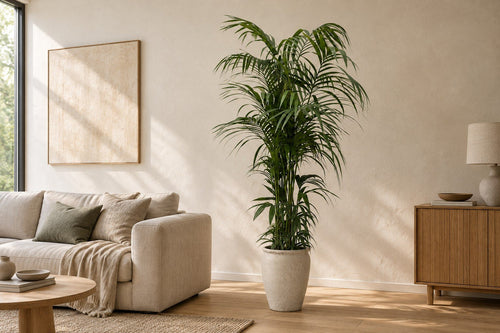
The Kentia palm (Howea forsteriana) is a large indoor palm from around 1 metre to over 2.5 metres tall. It tolerates lower light well, so it can also stand further away from the window.
The Kentia palms in this collection range from around 100 cm to 260 cm tall, priced from €49.95 to €319.95. We measure height from the bottom of the pot to the tallest leaf.
Around 100 to 130 cm, in a ø21 or ø24 cm pot: fits next to the sofa, by a reading chair or on a low plant stand.
220 cm in a ø38 cm pot: a free-standing palm for a living room or office with a standard ceiling height.
260 cm in a ø40 cm pot: for a high-ceilinged room, a mezzanine or a large hallway. You will find more plants this size among the XXL plants.
There is also a value bundle with a 200 cm Kentia, a 225 cm Strelitzia nicolai and a 200 cm Areca. Handy if you want to furnish a large space in one go.
Position and light
A Kentia prefers a bright spot, but without harsh midday sun on its leaves. Direct sunlight through glass can cause brown patches. A spot a few metres from an east, west or north-facing window usually works well. It also tolerates a somewhat darker corner, although it grows more slowly there. Avoid cold draughts and a spot right next to a radiator.
Watering and care
The Kentia is easy to look after, as long as you do not overwater it. A few rules of thumb:
Water when the top few centimetres of potting soil feel dry.
Never leave water standing in the decorative pot, soggy roots will rot.
Feed once a month in spring and summer with a fertiliser for green plants.
Cut old, brown leaves off close to the trunk.
Read more about care, brown tips and repotting in our Kentia palm care guide. Looking for a smaller palm for a bright windowsill? Take a look at the Chamaedorea palms.
Delivery and pot
Your Kentia comes in a nursery pot. You choose a decorative pot separately, so the style is up to you. In the Netherlands the plant arrives in 4 to 5 working days, upright in a sturdy plant box. Delivery within the Netherlands is free from €99. If anything is damaged on the way, send us a photo and we will send you a new plant free of charge.
Water when the top few centimetres of potting soil are dry. In summer that often works out at about once a week, in winter less. Do not leave water standing in the decorative pot, because the Kentia does not cope well with that.
Can a Kentia palm live in the shade?
A Kentia copes with less light than most palms. It grows best in a bright spot without harsh sun, but it also holds up in a somewhat darker corner. It will grow more slowly there and put out fewer new leaves.
Why is my Kentia getting brown tips?
Brown leaf tips are often caused by dry air, for example next to a radiator, or by the plant getting too much or too little water. Check the potting soil first. You can trim off the brown tips with clean scissors.
How fast does a Kentia palm grow?
The Kentia grows slowly. Indoors it usually adds a few new leaves a year. That is why it makes sense to buy the height you want straight away, rather than waiting for a small plant to grow.
Is a Kentia palm toxic to cats and dogs?
The Kentia palm is generally known as non-toxic to cats and dogs. Still, it is sensible to stop a pet from eating a lot of leaf, because that can upset any animal's stomach.
How often should I water my Kentia palm?
A Kentia palm wants water once a week in spring and summer and once every 10 to 14 days in autumn and winter. Only water when the top two centimetres of potting soil feel dry.
Is the Kentia palm safe for pets?
Yes, the Kentia palm is a pet-friendly choice. According to the ASPCA it is not toxic to dogs or cats on contact or if small amounts are eaten.
What is the difference between a Kentia and an Areca palm?
A Kentia palm has broad, gracefully arching leaves and grows upright on a single trunk. An Areca has feathery leaves in clusters and grows several stems. The Kentia is more shade-tolerant than the Areca.
How long does a Kentia palm live?
With good care a Kentia palm can live 40 to 60 years. In the wild they even reach ages of over 100 years. Indoors they grow slowly but very steadily.
Why are the leaf tips of my Kentia turning brown?
Brown leaf tips are usually caused by dry air, too little water or too much direct sun. Raise the humidity by misting regularly and check how much you water. Only trim brown tips at an angle, just before the healthy green.