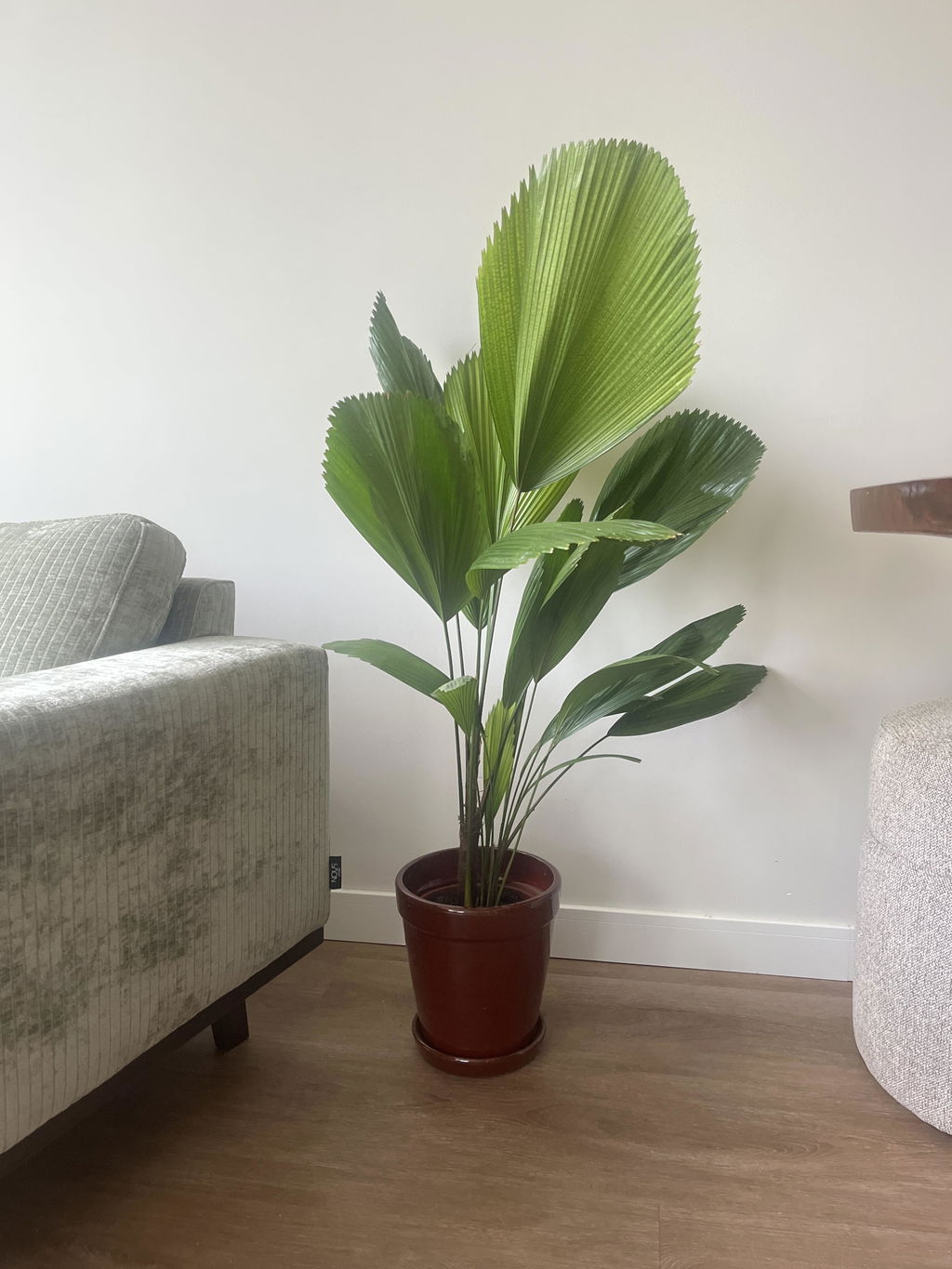



The Kentia palm is arguably the most elegant indoor palm you can bring home. With its graceful, arching feathered fronds it instantly brings a calm, classic atmosphere to a room, without asking any effort at all. What makes the Kentia so loved is that it is far less demanding than most palms: it tolerates less light and feels genuinely at home indoors. Whether you are a green beginner or already have a room full of plants, this palm is a rewarding companion that lasts for years.
In this guide you will read exactly how to care for a Kentia palm, from position and watering to neatly trimming brown tips. We also discuss the most common problems and how to solve them, so your palm stays healthy and full. Ready for a new green eye-catcher? Then take a look at our collection of large Kentia palms for a specimen that makes an immediate impression.
The Kentia palm in brief
Short on time? This is everything you need to know at a glance about caring for the Kentia palm:
- Light: bright, indirect light, but it also tolerates partial shade and somewhat darker spots. No harsh midday sun.
- Water: keep the soil evenly lightly moist. Let the top layer dry out between waterings.
- Position: warm and draught-free, ideally between 18 and 24 °C. Not below 12 °C.
- Humidity: likes somewhat higher humidity; dry air causes brown leaf tips.
- Pet-friendly: not toxic to cats and dogs.
- Growth: slow, but the palm becomes substantial over time.
About the Kentia palm and its origins
The Kentia palm, botanically known as Howea forsteriana, belongs to the palm family (Arecaceae). The plant comes originally from Lord Howe Island, a small island in the Pacific off the east coast of Australia. There it grows in the shade of larger trees, and it is precisely that natural habitat that explains why the Kentia copes so well with less light. It has become a classic over the years for good reason: as far back as Victorian times the Kentia adorned the drawing rooms of grand houses and hotels.
What makes the plant so recognisable are the long, gracefully arching leaf stalks with narrow, dark green leaflets. A mature Kentia palm can easily reach two to three metres indoors, though it takes its time: the plant is naturally slow-growing. That has an advantage, because a large Kentia palm keeps its shape for years and rarely needs repotting.
Light and position
This is where the Kentia palm really shines. Where most palms beg for a bright spot, the Kentia settles for much less. It likes bright indirect light but effortlessly tolerates partial shade and even somewhat darker corners of the house. That makes it ideal for places where other plants give up, such as a hallway, a bedroom or a corner further from the window.
Do avoid harsh, direct midday sun. The sun can scorch the leaves, causing yellow or brown patches. A spot by an east- or north-facing window is perfect, or a little further into the room by a south- or west-facing window. Put the palm in a warm, draught-free position: it copes poorly with draughts and cold air currents along doors or from air conditioning. The ideal temperature is between 18 and 24 °C, and never leave it below 12 °C for long.
Turn the pot a quarter turn now and then so the palm gets even light and does not lean towards the window. That way it keeps a good shape.
Watering
Watering the Kentia palm is a matter of balance. The plant likes evenly lightly moist soil, but is at the same time sensitive to too much water. Too wet is the biggest culprit: if the root ball stands in water for long, the roots can rot.
The practical rule of thumb: only water again once the top layer of compost (about the top two to three centimetres) has dried out. Push your finger into the soil to feel this. In summer that usually means watering about once a week; in winter it is less, often every ten to fourteen days. Always let excess water drain away properly and never leave the pot standing in a layer of water in the cachepot or saucer.
Note: the Kentia also copes poorly with being too dry. If the root ball dries out completely, the plant responds with brown leaf tips. The palm is also sensitive to substances in tap water such as lime and chlorine. If you have hard tap water, preferably use lukewarm rainwater or let the tap water stand overnight first.
Humidity
As a tropical plant the Kentia palm likes higher humidity than most living rooms naturally provide. Especially in winter, when heating dries the air out considerably, this can need attention. Air that is too dry is one of the main causes of brown leaf tips and also attracts spider mite.
You can help the palm with a few simple measures:
- Mist the leaves regularly with lukewarm, low-lime water, for example a few times a week.
- Stand the pot on a tray of wet clay pebbles or gravel, so the water evaporates slowly around the plant.
- Keep the palm out of the direct airflow of heating or air conditioning.
- Group the Kentia with other plants; together they create a more humid microclimate.
Feeding
Because the Kentia palm grows slowly, it needs little feeding. Too much fertiliser does more harm than good and can even cause brown leaf tips through salt build-up in the compost. So feed in moderation.
During the growing season, from roughly April through September, give the palm liquid plant food dissolved in the watering water every two to four weeks. Preferably use a feed for green plants or special palm fertiliser, at a slightly lower dose than stated on the packaging. In autumn and winter the plant rests and needs no feeding. Also never feed a bone-dry plant: moisten the soil first, so you do not damage the roots.
Repotting, step by step
The Kentia palm rarely needs repotting. It even likes a somewhat snug pot, and because it grows slowly, every two to three years is usually enough. The best moment is in spring, at the start of the growing season. Here is how to repot:
- Choose the right pot: take a pot only a few centimetres larger than the current one. Repotting into something far too big increases the risk of overly wet soil and root rot. Make sure there are good drainage holes.
- Add a layer to the bottom: put some clay pebbles in the base for smooth drainage.
- Carefully take the palm out of the pot: tilt the plant and support the base. Never pull hard on the stems.
- Inspect the roots: cut away any soft, brown or rotten roots with clean scissors. Healthy roots are firm and pale.
- Repot into fresh compost: use airy compost, preferably special palm or green plant compost. Set the palm at the same depth as before and top up with soil.
- Press down and water: press the soil down lightly and then water moderately, so the roots can recover.
Would you rather not repot? Then you can replace the top layer of compost with fresh soil each year instead. That gives the plant new nutrients without disturbing the roots.
Brown tips and trimming leaves
Brown leaf tips are by far the most frequently asked question about the Kentia palm, and almost every palm gets them sooner or later. The good news: in most cases it is cosmetic and the plant stays healthy. You can neatly trim the brown parts away to make the palm look well-kept again.
How to do it most attractively:
- Use clean, sharp scissors. Disinfect them beforehand if you like, so as not to transfer bacteria.
- Only cut away the brown, withered part and leave a very thin brown edge. If you cut into the green, a new brown edge immediately forms.
- Follow the natural shape of the leaf: trim the tip at an angle so the pointed shape is preserved and it looks natural.
- Is a whole leaf completely brown or yellow? Then cut the entire stalk away at the bottom, close to the base of the plant.
Important: never cut out the growing heart or the topmost, still-rolled tip of the palm. Unlike some plants, a palm grows from this point, and if you remove it that stem stops growing for good. So only remove old, damaged or brown parts.
Common problems
Is your Kentia palm not responding as you hoped? Below are the most common problems, with cause and solution.
Brown leaf tips
Cause: usually air that is too dry, but too much water, a dried-out root ball or substances such as lime and chlorine in tap water can also be the culprit.
Solution: raise humidity by misting and standing the pot on wet clay pebbles. Check your watering habits and preferably use rainwater or tap water left to stand. Trim the existing brown tips neatly using the tips above.
Yellow or brown leaves
Cause: older lower leaves turning yellow and dying off by themselves is normal. If many leaves turn yellow at once, however, that often points to too much water, or in fact too little.
Solution: feel the soil and adjust your watering. Remove fully yellow or brown stalks at the base. If the plant is structurally too wet, check for root rot.
Spider mite
Cause: spider mite is a tiny mite that feels at home in dry air. You recognise it by fine webbing between the leaves and small yellow speckles on the foliage. The Kentia palm is susceptible to this in dry air.
Solution: raise humidity, as that is the best prevention. Rinse the plant under a lukewarm shower and wipe the leaves. For persistent infestations you can use an organic control product based on potassium soap, for example.
Root rot
Cause: persistently wet soil, causing the roots to rot. This is the biggest danger with the Kentia palm. Symptoms are limp, yellowing leaves and a musty smell from the pot.
Solution: take the plant out of the pot and cut away all soft, brown roots. Repot into fresh, airy compost and water carefully afterwards. From now on always let the soil dry out at the surface first and ensure good drainage.
Is the Kentia palm toxic?
Good news for pet owners: the Kentia palm is not toxic to cats and dogs. So you can put this palm in your home with complete peace of mind, even if you have curious four-legged friends who like to nibble a leaf. That makes the Kentia one of the most suitable large houseplants for a household with animals or small children.
There is another nice quality on top of that: the Kentia palm is known as an air-purifying plant. Thanks to its substantial leaf mass it contributes to a fresh, green living environment. An eye-catcher that is not only beautiful but also welcoming and safe.
Kentia versus Areca palm
The Kentia palm is often compared with the Areca palm (Dypsis lutescens), and not without reason: both are popular indoor palms with feathered foliage. Still, there are clear differences that help you choose.
- Light: the Areca is more light-hungry and really wants a bright spot, while the Kentia copes well with less light and partial shade.
- Look: the Areca is fuller and bushier with numerous thin stems, the Kentia is more elegant and open with gracefully arching foliage.
- Care: the Kentia is generally a little easier and more forgiving, ideal if you want a rewarding palm.
Do you want a fuller, more luxuriant palm and have a bright spot available? Then the Areca is a fine choice. Are you looking for an elegant palm that also thrives in a somewhat darker spot? Then the Kentia is exactly right. View the finest specimens in our collection of large Kentia palms.
Frequently asked questions about the Kentia palm
How often should I water a Kentia palm?
On average about once a week in summer and every ten to fourteen days in winter. Only water again once the top two to three centimetres of soil has dried out, so the root ball stays evenly lightly moist without becoming too wet.
Can a Kentia palm stand in a dark spot?
Yes, the Kentia palm tolerates less light than most palms and does well in a partially shaded spot or a somewhat darker corner. That makes it excellently suited to indoors. Bright indirect light remains ideal, but total darkness and harsh midday sun are best avoided.
Why is my Kentia palm getting brown tips?
Brown leaf tips usually arise from air that is too dry, but can also come from too much water, a dried-out root ball, or lime and chlorine in tap water. Raise the humidity, check your watering and trim the brown tips neatly along the leaf shape.
Is the Kentia palm toxic to cats and dogs?
No, the Kentia palm is not toxic to cats and dogs. It is a pet-friendly houseplant you can safely put in your home, even with curious animals around.
How big does a Kentia palm get?
Indoors a Kentia palm can reach two to three metres. It grows slowly, though, so it takes several years to get there. If you want a substantial specimen straight away, choose an already mature plant.
Can I cut off the growing heart or the top of my Kentia palm?
No, never cut out the growing heart or the topmost rolled tip. A palm grows from that point and stops growing for good if you remove it. Only cut away old, brown or damaged parts.
What is the difference between a Kentia and an Areca palm?
The Areca palm is fuller and more light-hungry, while the Kentia palm is more elegant and copes better with less light. If you want a luxuriant palm for a bright spot, choose the Areca. If you want a graceful palm that also thrives in a darker spot, the Kentia is ideal.
7