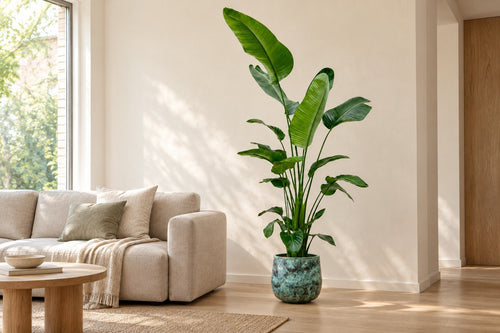
Ficus comes as fiddle leaf fig, rubber plant, weeping fig, Ficus Ginseng and Audrey, as a bush, branched or as a standard. Give it bright light and move it as little as possible so it keeps its leaves.
The Ficus lyrata, also called the fiddle leaf fig, is the largest group in this collection. It has large, stiff, violin-shaped leaves and grows upright. The rubber plant (Ficus elastica) has thick, glossy leaves and comes in green, dark red and variegated, such as the Robusta, Belize and Tineke. The weeping fig (Ficus benjamina) has lots of small leaves and often grows on a braided trunk.
You will also find less familiar species. The Ficus benghalensis 'Audrey', the banyan tree, has soft, light green leaves with clear veins. The Ficus ginseng stands out for its thick, gnarled roots and looks like a bonsai. There is also a Ficus umbellata, a Ficus cyathistipula and a variegated Ficus altissima.
Bush, branched or standard
The shape decides how the plant sits in the room. A bush has leaves from the pot upwards and fills a corner. A branched Ficus lyrata grows wider and fuller. A standard Ficus lyrata has a bare trunk at the bottom with a crown on top, so you can put a low cabinet or sofa next to it.
The plants in this collection range from 70 to 270 cm. For a windowsill or side table, a Ficus ginseng or a small 75 cm lyrata fits well. For a high-ceilinged living room or an office with plenty of headroom, take a look at the XXL plants of 200 cm and taller. We measure height from the bottom of the pot to the tallest leaf.
Position and light
All the figs here like partial shade. They want a bright spot, for example a few metres from a window, without harsh midday sun through glass. A ficus does not like being moved or draughts. After a move it sometimes drops a few leaves, which usually recovers by itself if it keeps a permanent spot. Do not put it right next to a radiator or a door that opens often.
Water and care
Water when the top few centimetres of potting soil feel dry. Do not let the plant sit in a layer of water, because soggy roots are the most common cause of problems. A ficus needs less water in winter than in summer. Wipe the large leaves of a lyrata or rubber plant with a damp cloth now and then, so they catch more light. Read more tips in our Ficus care guide.
Delivery
Within the Netherlands your ficus arrives in 4 to 5 working days. It travels upright in a sturdy plant box. Delivery within the Netherlands is free from €99. If anything does get damaged on the way, send us a photo and we will send you a new plant free of charge. Every ficus comes in a nursery pot, and you pick a decorative pot separately.
The rubber plant (Ficus elastica) is considered one of the easiest. It tolerates somewhat less light, and if you forget to water it once, its thick leaves help it cope. The Ficus lyrata is a bit more sensitive to being moved and to irregular watering.
Why is my ficus losing its leaves?
Leaf drop is usually caused by a change: a new spot, draughts, a cold windowsill or too much water. A ficus especially tends to drop some leaves after delivery or a move. Give it a permanent, bright spot, let the soil dry out a little in between and wait a few weeks.
How much light does a ficus need?
A ficus wants plenty of light, but preferably no harsh midday sun directly through glass. A spot one to three metres from an east or west-facing window works well. With too little light it leans towards the window and new leaves come out smaller.
Is a ficus toxic to cats and dogs?
None of the figs in this collection are listed as pet-friendly. Figs have a white milky sap that can irritate the skin, mouth and stomach. If you have a cat or dog that nibbles plants, keep the ficus out of reach or choose a different plant.
How big does a ficus get indoors?
Indoors a ficus keeps growing steadily. A Ficus lyrata or rubber plant can reach the ceiling after a few years if it gets enough light. If it gets too tall, you can prune it back in spring. It will then sprout below the cut.
How often should I water my Ficus?
A Ficus wants water once a week in spring and summer and once every 10 to 14 days in winter. Let the top 2 cm of potting soil dry out between waterings. Too much water is the main cause of leaf drop and yellow leaves.
Is a Ficus toxic to dogs and cats?
Yes, the Ficus is mildly toxic to pets. The white milky sap released from damaged leaves or stems can cause skin and stomach irritation in dogs and cats. Place the plant out of reach of pets that like to chew.
What is the difference between Ficus Lyrata and Benjamina?
The Lyrata has large, leathery, violin-shaped leaves and grows upright with a stately look. The Benjamina has small glossy leaves and gracefully drooping branches. The Lyrata is more graphic and modern, the Benjamina more classic and better known as an air-purifying plant.
How long does a Ficus live?
With good care a Ficus can live 20 to 50 years as a houseplant. In the wild some species live for hundreds of years. A permanent spot, regular watering and repotting every 2 to 3 years all help it live long.
Why is my Ficus dropping leaves?
Leaf drop in a Ficus is usually a stress reaction to change. Common causes are moving, draughts, sudden temperature swings or too much water. Give the plant a permanent spot and keep watering consistent, and it usually recovers quickly.